
UAE Updates Property Visa Framework: No Minimum Investment Required for 2-Year Residency
A strategic shift that reinforces the UAE’s position as one of the world’s most attractive jurisdictions for global investors, international families, and long-term wealth structuring.

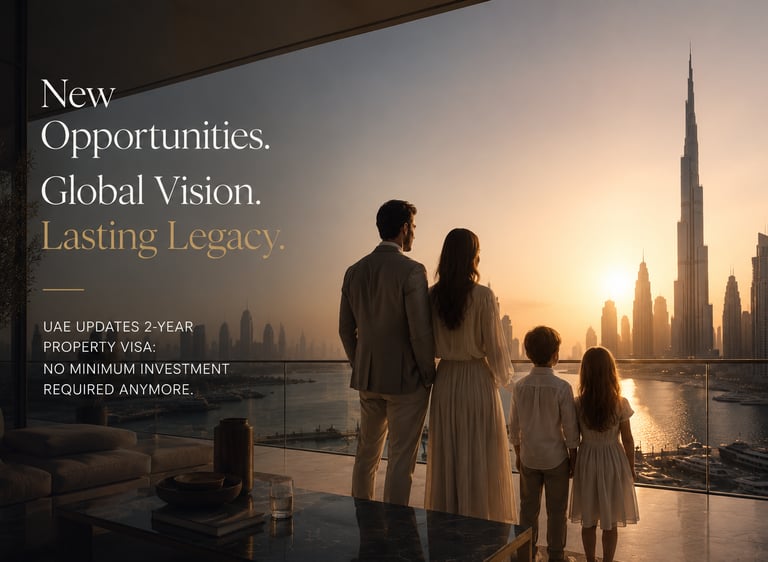
The United Arab Emirates continues to strengthen its position as a global hub for capital, residency, and international mobility. In its latest regulatory evolution, the UAE has updated the framework surrounding the 2-year property-linked residency visa, removing the previous minimum investment threshold that historically limited access to the program.
The update represents more than a procedural adjustment. It reflects a broader strategic movement by the UAE toward flexibility, accessibility, and long-term economic positioning, especially in a market increasingly shaped by global capital mobility and internationally diversified investors.
For individuals and families seeking international exposure, geographic diversification, and asset protection, the announcement reinforces the UAE’s growing relevance within sophisticated cross-border wealth planning strategies.
A More Flexible Residency Environment
Historically, obtaining a UAE property-linked residency visa required investors to meet a defined real estate investment threshold. Under the updated approach, residency eligibility is now significantly more accessible, particularly for investors entering the market through financed acquisitions or lower-ticket strategic real estate positions.
This evolution expands opportunities for a wider range of international investors while simultaneously stimulating the country’s real estate ecosystem and broader financial environment.
Dubai, Abu Dhabi, and other emirates continue to attract substantial international demand due to a combination of factors:
Political and economic stability
Tax efficiency
Strong banking infrastructure
International lifestyle appeal
Strategic geographic positioning
Regulatory modernization
High levels of global connectivity
The UAE’s ability to integrate residency pathways with investment opportunities has become one of its strongest competitive advantages in the global mobility landscape.
Why This Matters Beyond Real Estate
While the headline focuses on residency visas, the deeper strategic relevance lies elsewhere.
The UAE increasingly operates as a jurisdictional platform for international wealth organization, not simply as a destination for property acquisition.
For globally exposed families and entrepreneurs, residency diversification plays a critical role in broader planning considerations involving:
Asset protection
International banking access
Tax residency planning
Succession organization
Family mobility
Business expansion
Long-term jurisdictional diversification
This is particularly important in a global environment marked by increasing fiscal pressure, regulatory complexity, geopolitical uncertainty, and expanding transparency obligations across jurisdictions.
Sophisticated investors are no longer concentrating their personal residency, corporate structures, assets, and financial exposure within a single country.
Instead, they are adopting a diversified international architecture designed to preserve flexibility, security, and long-term continuity.
Diversification Is No Longer Optional
One of the most important shifts among high-net-worth individuals globally is the transition from concentrated wealth exposure toward multilayered international structuring.
This does not necessarily mean abandoning a home country or transferring all assets abroad. Rather, it involves strategically distributing exposure across jurisdictions, currencies, legal systems, and asset classes.
The UAE has emerged as one of the preferred jurisdictions within this strategy because it combines several critical elements rarely found simultaneously in other markets:
Modern regulatory infrastructure
International business environment
Strong real estate demand
Global banking access
Favorable taxation
Legal modernization
Residency flexibility
Long-term geopolitical positioning
In practical terms, investors increasingly view UAE residency not merely as an immigration benefit, but as part of a broader wealth preservation and international positioning strategy.
Real Estate as a Strategic Gateway
Property acquisition in Dubai and other UAE markets increasingly functions as an entry point into a larger ecosystem of international opportunities.
Many investors initially enter through real estate exposure and later expand into:
International holding structures
Family office arrangements
Cross-border succession planning
Trust and foundation structures
International banking relationships
Global business operations
Tax optimization frameworks
The updated residency rules further accelerate this movement by lowering barriers to entry and expanding access to international structuring opportunities.
At the same time, the UAE real estate market continues to demonstrate resilience and long-term attractiveness, supported by infrastructure investment, population growth, tourism expansion, and sustained foreign direct investment.
The Importance of Strategic Structuring
Despite the attractiveness of the UAE framework, residency and investment decisions should never be approached in isolation.
International structuring requires coordinated analysis involving:
Tax residency implications
Reporting obligations
Asset ownership structures
Succession considerations
Banking compliance
Multi-jurisdictional exposure
Family governance objectives
What appears beneficial from an immigration perspective may generate unintended tax or legal consequences if not properly structured.
This is precisely why sophisticated families increasingly seek integrated advisory support capable of aligning mobility, asset protection, tax efficiency, and long-term legacy planning within a unified strategy.
A New Era of International Wealth Mobility
The UAE’s latest visa update reflects a broader global reality: capital, residency, and wealth are becoming increasingly interconnected.
As governments around the world tighten fiscal oversight and global investors seek stability, flexibility, and protection, jurisdictions capable of combining regulatory sophistication with strategic openness will continue attracting international capital.
The UAE is positioning itself at the center of that movement.
For investors and families evaluating international diversification strategies, the message is increasingly clear:
The future of wealth preservation will belong to those who structure globally, diversify intelligently, and plan beyond borders.
At Larson Wealth & Legacy, we assist international families, entrepreneurs, and investors in structuring sophisticated cross-border strategies involving residency planning, asset protection, international tax coordination, and long-term wealth preservation.
Our multidisciplinary approach combines global vision, technical precision, and strategic jurisdictional integration designed for families operating across multiple countries and financial ecosystems.
To explore how UAE residency and international structuring strategies may align with your long-term objectives, contact our team for a confidential consultation.
LARSON WEALTH & LEGACY 2026. ALL RIGHTS RESERVED
We do not carry out any activity in the United Arab Emirates regulated by the Central Bank of the UAE, the SCA, the Insurance Authority or the DFSA, unless expressly authorized. Any references to investments, financial products, trusts or similar structures are for general informational purposes only and do not constitute an offer of regulated services in the UAE or the DIFC.


Developed by: AVANCE propaganda